
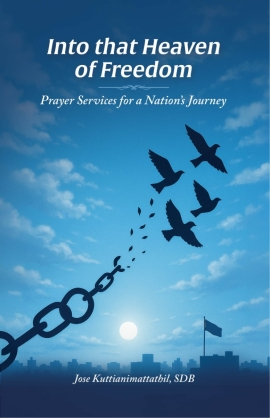
In an era increasingly shadowed by authoritarian impulses, strident nationalism, and widening social inequalities, India—the world’s largest democracy—stands at a decisive moral and political threshold. Public institutions wrestle with questions of integrity and accountability, and citizenship can no longer afford the comfort of passive spectatorship. Democracy, this book compellingly argues, is sustained not by indifference but by vigilant, ethical, and prayerful participation—by priests, religious, and laity alike.
Drawing inspiration from Mahatma Gandhi’s conviction that prayer, “properly understood and applied,” is among the most potent forms of action, Fr. Jose Kuttianimattathil, SDB, offers a work that is at once spiritually grounded and socially engaged. The theological architecture of the volume is both solid and carefully constructed. Rooted in Sacred Scripture and nourished by the Catechism of the Catholic Church and the social magisterium—particularly Evangelii Gaudium, Fratelli Tutti, and Deus Caritas Est—the author presents political participation not as optional activism but as a moral responsibility flowing from human dignity, baptismal vocation, and commitment to the common good. In continuity with the Church’s teaching that politics is a “lofty form of charity,” he advances a distinctive and compelling insight: prayer itself is an indispensable expression of that charity.
One of the book’s notable strengths lies in its ecclesiological clarity. With pastoral prudence, the author distinguishes the specific political engagement proper to the laity from the prophetic and intercessory mission entrusted to priests and religious. Without collapsing these roles or retreating into quietism, he safeguards both ecclesial communion and public witness. Clergy and religious are neither politicised nor rendered mute; rather, they are called to animate conscience, sustain moral vision, and uphold the spiritual foundations of democratic life. This balanced and nuanced approach proves particularly valuable in contexts where the Church must navigate the delicate space between principled engagement and partisan entanglement.
The volume’s practical heart is found in its carefully composed prayer services, designed for pivotal national moments—elections, commemorations, times of unrest, and celebrations of democratic ideals such as truth, justice, freedom, and non-violence. Yet these are far more than ceremonial texts. They embody a profound integration of lex orandi and lex vivendi: prayer becomes a formative act that shapes conscience, deepens social awareness, and cultivates civic responsibility. Organised thematically around constitutional values, governance, media, human rights, and national crises, the prayers reveal a holistic vision of politics that transcends electoral processes and attends to structures, cultural narratives, and the moral imagination of a people.
Particularly evocative is the author’s imagery of believers as both “Joshuas on the battlefield” of public life and “Moseses on the mountain” in intercessory prayer. The dual vocation—engaged action and contemplative fidelity—captures the essence of the book’s vision. At its center stands what the author calls “irresistible prayer”: prayer that refuses complacency, purifies motives, inspires courageous service, and participates mysteriously yet powerfully in shaping a nation’s destiny.
Published by Kristu Jyoti Publications and released on 31 January 2026, the Feast of St John Bosco, Into That Heaven of Freedom emerges as a timely and substantial contribution to contemporary reflection on faith and public life. It will be of enduring value to religious communities, educators, pastoral leaders, and students of social ethics—indeed, to all who believe that democracy must be sustained not only by laws and institutions, but by consciences formed in truth and hearts strengthened in prayer.
More than a manual of services, this work is a summons: to rediscover prayer as a dynamic force within history and to journey, as a people, toward that “heaven of freedom” where justice and compassion meet.
Authored by Fr Jose Kuttianimattathil, SDB, member of the Formation Department of the Salesians of Don Bosco in Rome, for “Kristu Jyoti Publications”