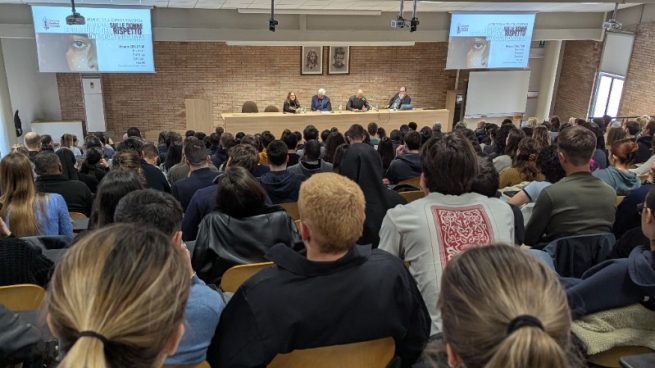
(ANS – Rome) – A silent, attentive lecture theatre, filled with emotion and reflection: this was the atmosphere that accompanied the meeting of the Pontifical Salesian University (UPS) academic community of the on 18 March 2026, on the theme “Violence against women and a culture of respect: an educational challenge”, which arose from a direct request by the students.
The proceedings were opened by the Rector of the UPS, Prof. Fr Andrea Bozzolo, who highlighted the responsibility of the educational world in the face of a phenomenon as widespread as it is complex. It is not enough to condemn violence, he emphasised: it is necessary to understand it, recognise it and prevent it.
But it was above all the testimony of Filomena Di Gennaro that marked the most intense moment of the meeting. A survivor of an attempted murder by her ex-boyfriend in 2006, she now lives in a wheelchair. Her account did not limit itself to the drama of the event, but highlighted what preceded it: subtle signs, often invisible to those experiencing them. Control, psychological pressure, jealousy, restriction of personal freedom: dynamics that can be mistaken for love, but which in reality represent its negation. “We always think that certain things happen to other people,” she explained to the students in the lecture theatre, pointing to this very underestimation as one of the main obstacles to prevention.
The strongest point of her reflection focused on the theme of possession. “Mine or no one else’s”, the words her attacker addressed to her before shooting her. A phrase that today, in her message, becomes a warning to be overturned: no one belongs to anyone. Hence the call, addressed above all to young people, to recognise the signs of an unhealthy relationship and not to remain silent. Alongside her condemnation, her testimony also offered a glimmer of hope: the possibility of rebuilding one’s life and living in healthy relationships, founded on respect and reciprocity.
Building on this account, Prof. Marco Pacifico offered a psychological analysis of the phenomenon, highlighting how at the root of many violent relationships lies a profound fragility of identity. In these dynamics, the other person ceases to be a person and becomes an object, serving to fill an inner void. Relationships marked by emotional dependence, control and an inability to accept the other person’s autonomy. Situations that are difficult to recognise from within, the professor emphasised, and this is precisely why the role of those around them – friends, family members, educators – is so crucial.
There are no quick fixes, nor shortcuts: change requires time, awareness and profound journeys, far removed from the simplifications often found in public debate and on social media.
Prof. Alessandro Ricci’s talk focused precisely on the educational sphere, highlighting an increasingly evident void: the lack of a genuine affective and emotional education. Today, he observed, children and adolescents grow up immersed in a digital environment that presents often distorted relationship models. The internet, pornography, social media and musical content effectively become the primary educators, whilst families and schools struggle to fulfil this role. Technology, he explained, is not the problem in itself, but it profoundly changes the way we experience relationships: it reduces waiting times, facilitates the immediacy of impulses and creates emotional distance. A distance that can lower inhibitory barriers and make the transition to aggressive behaviour easier.
Hence the urgent need for a new educational commitment, capable of developing fundamental skills in young people: recognising emotions, naming them, learning to manage them and communicate them. Without this work, the risk is a growing inability to maintain healthy relationships.
The meeting was brought to a close by the Rector, Fr Andrea Bozzolo, with a direct appeal to personal responsibility. The problem, he observed, is not a lack of principles: on these, in theory, everyone agrees. The real challenge is to translate them into behaviour. Education does not merely mean imparting knowledge, but accompanying an inner journey, one of awareness, of confronting one’s own frailties and of emotional maturation. In this context, authentic love is defined as the recognition of the other’s uniqueness and the ability to support their growth, overcoming any logic of possession.
The meeting concluded with questions and reflections, leaving the students with the realisation that gender-based violence is not a distant issue, but a reality that affects everyone. And prevention begins, first and foremost, with education.