Portugal – Psychologists and educators take part in Salesian webinar on young people’s mental health
Home » Salesians » General Council » Portugal – Psychologists and educators take part in Salesian webinar on young people’s mental health
Portugal – Psychologists and educators take part in Salesian webinar on young people’s mental health
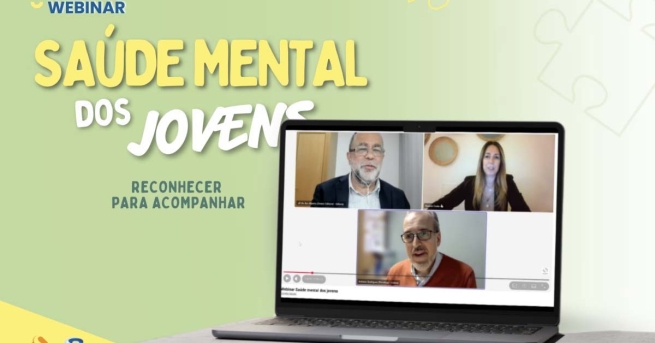
(ANS – Lisbon) – Around 700 educators registered for the webinar on young people’s mental health organised by the publisher “Salesianos Editora” and “Fundação Salesianos” – two different Salesian bodies in Portugal. Hundreds followed the live presentation on 9 March of the Portuguese edition of the book “Mental Health of Young People: Recognising to Accompany”, published in 2025 by the Salesian Youth Ministry Sector, and the webinar featuring two guest psychologists, António Rodrigues and Rosário Costa, both with extensive experience in supporting young people in Salesian educational settings.
The presentation was aimed at educators, parents, guardians, teachers, catechists, scout leaders… who logged on in large numbers from Viana do Castelo, Loulé, Braga, Funchal, Cerveira, Moura, Portimão, Figueira da Foz, Porto, Lisbon and Mirandela, confirming the great interest the topic generates in schools, youth circles and society in general.
Various national and international studies have shown a statistical increase in anxiety and depression among young people. At the same time, there is also greater awareness of the problem. Psychologist Rosário Costa explained that, although anxiety is also present in younger age groups – even among primary school children – it is more common in older age groups, when the ability to rationalise and self-awareness become more ‘developed’. “This greater awareness has also led more people to seek medical help,” the psychologist noted.
Admitting that it is sometimes difficult to “describe and identify the boundaries between the various types” of problems, Rosário Costa sought to identify genetic, psychological, environmental and social factors, and to dispel certain myths and false beliefs on the subject.
The psychologist also presented tools for addressing anxiety in an educational setting, including various self-awareness and reflection techniques, breathing and relaxation techniques, role-play, body scan, positive visualisation, group activities and trust-building exercises, to explore some resources that educators can study and utilise.
A strong social support network is essential
One condition that has seen a rise in incidence among young people over recent years is depression. António Rodrigues identified the early “negative and persistent” warning signs of depression in young people as “a loss of pleasure, a lack of energy and hope”, “as if the future could only be the same or worse.”
“Today, the prevalence of the condition ranges from 8 to 16 per cent of the global population,” he stated. “Depression is currently the second leading cause of disability worldwide and is expected to become the leading cause by 2030.”
António Rodrigues explained that there is a multifactorial framework underlying this increase. Greater awareness, an ageing population, and increased exposure to stressors – where social media also plays a role – are some of the factors contributing to this rise, according to the psychologist. “Depression is highly debilitating. The person is unable to envisage the future. It is not a mood swing; it lacks the same volatility; in depression, that is not possible. Depression is a serious illness,” he continued. “There are various causes—genetic, hormonal, a life event—that can trigger depression. “It should not be confused with weakness of character or limitation,” the psychologist reiterated, noting that this is a stigma often held even by the sufferer themselves.
For António Rodrigues, there is a “distortion of reality with over-stimulation of the ideal and under-stimulation of self-perception”. For the psychologist, there is no doubt that in these cases pharmacological therapy is necessary and that “there are no quick fixes”.
Social media and the mental health of children and young people
The importance of having a strong social support network and primary prevention was emphasised by both specialists. The audience, watching from home, had the opportunity to ask the two guests some questions, and they sought to offer further help by suggesting useful resources and warning signs to look out for.
The influence of social media on the mental health of children and young people was also addressed by several participants. Rosário Costa noted that in recent years schools have been implementing certain rules. According to the psychologist, the changes introduced “have been well received” by schools. In this context, António Rodrigues added that “we are also trying to ensure that young people become aware of what is positive and what is negative”. “They themselves, at times, lack a critical perspective,” he explained. “And young people find it very difficult to regulate themselves, and have great difficulty managing frustration,” added Rosário Costa.
Finally, the Editorial Director of “Salesianos Editora”, Fr Rui Alberto, noted that the interest generated by “Mental Health of Young People: Recognising to Accompany” and the webinar is a sign that people are “attentive” to the issue. “That is already a step forward,” he said. The Salesian priest also emphasised that the launch of this book is intended as an aid for educators, is easy to read, and should not replace “seeking specialist help”.
Source: Salesians of Portugal